Showing posts with label Camera. Show all posts

Thursday, April 11, 2013

All your Canon are become to obsolete

   Back in grade school I used to enjoy playing handball with all the kids at recess.  At first I had no idea what I was doing, fumbling around trying to hit that ball, eventually I some kind friends and older kids decided to show me the ropes and taught like the 'chop', an 'ace' and the 'lob'.  After a while I got the hang of it and started getting good,  but there was also that one kid with the move I could never defend against, the dirtiest of tricks, the 'Black Magic'.
  So I have an idea of how Canon must feel at this year's NABshow (National Association of Broadcasters) when their newest competitor, Black Magic Design, showed up with this:
http://www.blackmagicdesign.com/products/blackmagicpocketcinemacamera
   The Black Magic Pocket Cinema Camera is a Full HD (1920x1080) resolution video camera that records its footage without any added processing, generally called RAW recording.  This is a very important feature for a video camera to have if image quality is important to you.
   The DSLR Revolution bought with it 'close to' Cinema camera image quality for a tenth of the price, creating an explosion of Indie Filmmakers and Videographers, wonderful as they are were not without their short comings.
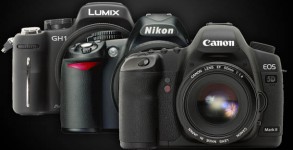
Common Video DSLRs
Canon ultimately pulled ahead of the competition, due in no small part to the help of their 'kind friends' in the Magic Lantern community which provided their DSLRs with very useful video centric features aimed at the professional and enthusiast users.  Five years after the release of the first video enabled DSLRs and many updates later the manufacturer's finally began providing the features their users were looking for; but by doing so hit a proverbial wall of advancement, any further would start to contend with their Professional Camcorder and Cinema Camera offerings so it seemed the remaining issues left unattended were here to stay. 
magiclantern on Canon EOS 7D
   Like myself learning grade school handball, the manufactures made plenty of mistakes in their early models; Nikon fumbled their D90 with a limiting resolution option and poor encoding codec, Canon improved on that with the 5D mark II but forgot manual exposure settings and limited their frame-rate options, Panasonic with their GH1 was arguably the best hardware and software for the job but had very limited bit-rates for their encoding bandwidth while Sony and others slowly crept into the market.  
  Just as the DSLR manufacturers started to get the hang of this market with real winners like the Canon 5D mark III and Panasonic GH3 a relatively new company to the camera manufacturing game shows up with a real 'game changer'.  This new camera from Black Magic Design not only addresses the issues plaguing all DSLR but it also provides an image quality that directly competes with the Professional Camcorder and Cinema Cameras, revealing just how fragile the line between the two are. 
The Black Magic Pocket Cinema Camera with a $26,000 Cinema zoom lens.
Many have rightfully said how the Canon 5D mark II (along with Magic Lantern) has broken down the walls of entry to the professional video industry but this camera has just blown up any remanence of that wall to dust!  But that's enough hype, let's get down to specifics and see what this camera is all about.
The most important part of any camera is the imaging sensor, thanks to some friends on the EOSHD Forum, they've narrowed down the likely sensor as either the CIS1910F or the CIS1021 both from Fairchild imaging which they described as sCMOS sensors "...ultra low-noise CMOS image sensor intended for scientific and industrial applications requiring high quality imaging under extremely low light levels." this estimation was based on the fact that Black Magic Design's other model, the 'Black Magic Cinema Camera', currently uses an sCMOS sensor from Fairchild imaging which Black Magic Design's Public Relations has claimed offers the exact same image quality as the new BMPocketCC.
Fairchild imaging's CIS1021 sCMOS
BMPocketCC diagram mockup


Which ever sensor ends up in the BMPocketCC promises 13 stops of Dynamic Range in 12 bit image files, minimal rolling shutter and a 1600 ISO image clean of signal noise.  Compared to Canon's 5D mark III with its 10 stops of dynamic range the BMPocketCC offers 6x more detail in the highlights and shadows of the image.  The 12 bits color space means 4,096 shades of each color which is 8x more accurate color reproductions than any current DSLR with their 8 bit codecs and even more accurate than some Professional Camcorders.  Rolling shutter effects appear better than any DSLR I've seen but that is a subjective matter and the ISO noise is on par with today's current offerings from most newer models. 
Even having the best sensor in the world, which BAE Systems considers to be the CIS1021, means nothing if coupled with a poor quality image codec.  Encoding codecs are very important in a modern day video camera, it compresses the image data so that it can be easily stored on a removable media device such as a memory card or on computers with smaller hard drives.  I mentioned before that the BMPocketCC provides RAW video footage, in a CinemaDNG lossless compression wrapper, but that may not be the best choice for every situation so the camera also provides a 10bit 4:2:2 ProRes HQ lossy compression Intra-frame codec which 'throws away' some image data while only causing a minimal amount of visual degradation unlike DSLR's 8bit 4:2:0 AVC lossy compression Inter-frame codec which throws away twice the color information as well as reducing the color accuracy by a factor of 4 when compared to Apple's ProRes HQ.  The AVC was designed as a 'delivery codec' meant to help stream a video over the internet or squeeze onto an optical disc while ProRes is an 'acquisition codec' which reduces size while attempting to preserve the information needed for editing and manipulating an image.
Apple iPhone 4 smart phone
Sony's NEX 3 mirrorless camera
Its looks remind me of an Apple iPhone 4 while its form factor is clearly inspired by Sony's NEX line of mirrorless cameras.  It uses the very affordable and common Nikon EN-EL20 battery, the lens mount accepts Micro Four Thirds lenses and employs an 'active' electronic communication for those lenses to control their apertures with either a push button auto exposure or through manual incremental steps.  Their are no automatic modes for shutter speeds, image gain, white balance or focus which may turn some people away but it was intended for those that require manual settings to ensure the camera stays locked in to their delicately chosen settings.  The camera does however offer focus peaking which outlines object that are in focus to help manual focusing accuracy and 'zebras', an exposure assist feature to check for blown out highlight details, it also does not take photos but supports a time-lapse function.
The idea of having a pocket sized RAW video recorder is too good to pass up, especially considering its price at just $995, so I suggest pre-ordering this because it's very unlikely you'll be finding BlackMagic Design in any retail store and judging by its popularity since the announcement, if you don't order early you might not be seeing them at all since BlackMagic Design doesn't have the best record at filling their back-orders quickly.  Understand though, technically it will 'work' with as little as a $13 SD card and a $100 lens, but that just makes this a suitable toy rather then a tool, which is perfectly fine if this is for a hobby or you're using it to learn on; if you need this to make you money prepare to spend a bit more than $995.  To incorporate it into my work I'm not only going to need more accessories to run it as a reliable A or B cam but also more drive space and beefier computer parts to handle the bigger files and higher quality images, so I'm likely looking at another $1,100 - $2,000; potentially the same cost range as adding a 5D mark III or D600 or GH3 or NEX VG30 if not more... but with the BMPocketCC it forces me to get ready for a 'RAW/Low Compression' workflow which I think was BlackMagic Design's point and not really a bad idea for me to do. 

-http://www.blackmagicdesign.com/products/blackmagicpocketcinemacamera/techspecs
-http://www.bhphotovideo.com/c/product/964117-REG/blackmagic_design_blackmagic_pocket_cinema_camera.html

Saturday, May 5, 2012

What is Diffraction?

I just received some concerning news, it turns out my beloved Photos are showing signs of being Diffraction Limited. Are you one of the many Digital Photographers or Videographers suffering from Diffraction?  The test is easy and can be preformed in the privacy of your own computers so please help stop this growing epidemic and get your images checked.

Squint your eyes down, smaller, smaller still, until they are just barely open. What you notice is that the smaller your eyes get the darker and softer your vision becomes. You have just observed a crude example of Light Diffraction.  For the quick solution don't stop down past F/8 then use ND Filters to protect your Photos from Diffraction, it's like how throwing a pair of sunglasses over your eyes get you a darkened image without nearly as much loss of sharpness.

As a Photographer I felt the need to better understand Light and although I am not a Physicist I do know that the 'what', 'how' and 'whys' of Light are still under debate and that a conversation about Particle-Wave Duality is best left to the Quantum Physicists. What a Photographer dealing with Diffraction needs is to understand Light as a Wave. A Light Wave emits from it's source in all directions; what has helped me is to imagine Light as a growing bubble of Photons moving out as a tightly shaped sphere that is immediately followed by another wave and moving faster than the eye can register. They race away until they crash into an obstacle, as the surface of the obstacle is bombarded with photons each point of contact becomes a new point of emission sending another wave of photons back in the other direction. 

Light moves outward as a Radial Wave so when it rushes passed an edge it not only hits one side and reflects back but also around the corner to the second side of the edge reflecting waves across as well. When Light encounters an obstacle with multiple edges in close proximity, like your nearly closed eye lids or the inner edge of a Lens Aperture, the light waves reflect across from one inside edge across to the other and back again sending waves back and forth across the small opening. The opposing waves overlap and interferes with the portion of the wave that made it past the edge cancelling out and redirecting some of the light that passes near the edge off to an extreme angle reshaping the wave that emits out of the obstacle into a wider angle reducing brightness and sharpness that make its way to the sensor.

A Digital Photographic Sensor, like a Georges Seurat pointillism painting, is made up of tiny "Pixel-Sensors".  An Image is projected from the back of a Lens onto the Sensor like a tiny movie theater inside your camera. Then each of these microscopic Pixel-Sensors record one microscopic point of the projection and save it as one pixel of the digital photograph.  However these Pixel-Sensors also have their own edges where the light diffracts, the smaller the Pixel-Sensors the more susceptible they are to diffraction caused by the lens aperture.  A modern day "Full Frame" Camera has Pixel-Senors of about 6.25 microns and an "APS-C" Camera of today has 4.3 microns.

Now 

The solution to avoid diffraction is to keep your Iris settings wide and use the largest and/or highest resolution sensor you can; but understanding why and what your particular camera's diffraction limit is important to getting the sharpest images possible from your lenses.

Basically Diffraction is the lens not getting enough light to the sensor's individual photodiodes to properly resolve your image.  A high resolution sensor has more physical photodiodes, but they have to squeeze them into the same amount of space so the photodiodes need to be smaller which means they have more trouble saturating and when closing down the aperture reducing the light through the lens.  When a pixels next to each other are made from photodiodes that are under-saturated it translates to lower contrast and creates a softer image. That's the easy explanation anyway.
Technically the lens is an obstacle for light to squeeze through, it forces the light down together and then spreads back out at a weaker intensity.  Think of light-rays like waves of water moving through an obstacle, turning strong aggressive waves into a weak gentle ripple.  In a camera the light also needs to squeeze through the aperture and the smaller the aperture the more narrow the flow which cuts down more light-rays that can get through, the light-rays that make it through are then spread back out to cover the sensor area, which results in wider yet weaker light-rays. Modern day 'Bayer Pattern Array' CMOS Sensors are actually a grid of microscopic sensors called photodiodes or 'Pixel Wells'. These 'Pixel Wells' are very small, measured in microns, and each 'Pixel Well' should record a different ray of light than its neighboring 'Pixel Well'; together they are resolving an image down to their microscopic micron's size, which we preserve as fine details, micro contrast or sharpness.  When the individual light-ray are wider than the sensor's microscopic micron sized pixels then each pixel will start to record part of the light-ray of its neighboring pixel, the more they overlap the more similar each pixel is which effectively lowers your pixel count (resolution) and the softer the image appears, a "fully diffracted image" may render 9 individual pixels as 1!  Turning an 18 megapixel image into a 2 megapixel one.  That is called the diffraction effect.

The higher the resolution of a sensor the smaller its 'Pixel Wells' need to be so that they can physically fit on the sensor and the faster they'll reach a diffracted state, called the diffraction limit.  This is why for higher resolutions it is important to use a physically larger sensor; although an argument can be made that higher resolution sensors are still higher resolution when fully diffracted (9 pixels act as 1) than a lower resolution sensor and that is true but only in very extreme cases, for example a fully diffracted 60 megapixel image would be 6.6 megapixels which is still higher resolution than the sensor of my first Canon DSLR, the EOS D60 (6.3 megapixels) which I was still able to make passable 8 x 10 prints with.  Right now we are at about 20 megapixels on most DSLRs and those diffraction limits (that when the diffraction effect starts) are f/11 for Full Frame and f/8 for APS-C; the higher we go the less exposure choices we'll have, one day we might even be diffraction limited at f/2.8... but that's quite a ways off.
Cambridge in Color has a great description of diffraction with very detailed examples and even an interactive 'diffraction calculator', I recommend going back there to carefully read the article and try out their calculators to get a thorough understanding of this effect.


"Diffraction is an optical effect which limits the total resolution of your photography — no matter how many megapixels your camera may have. It happens because light begins to disperse or "diffract" when passing through a small opening (such as your camera's aperture). This effect is normally negligible, since smaller apertures often improve sharpness by minimizing lens aberrations" -http://www.cambridgeincolour.com/tutorials/diffraction-photography.htm